

 Europe | €
 Deutschland | €
 Italy | €
 Polska | zł
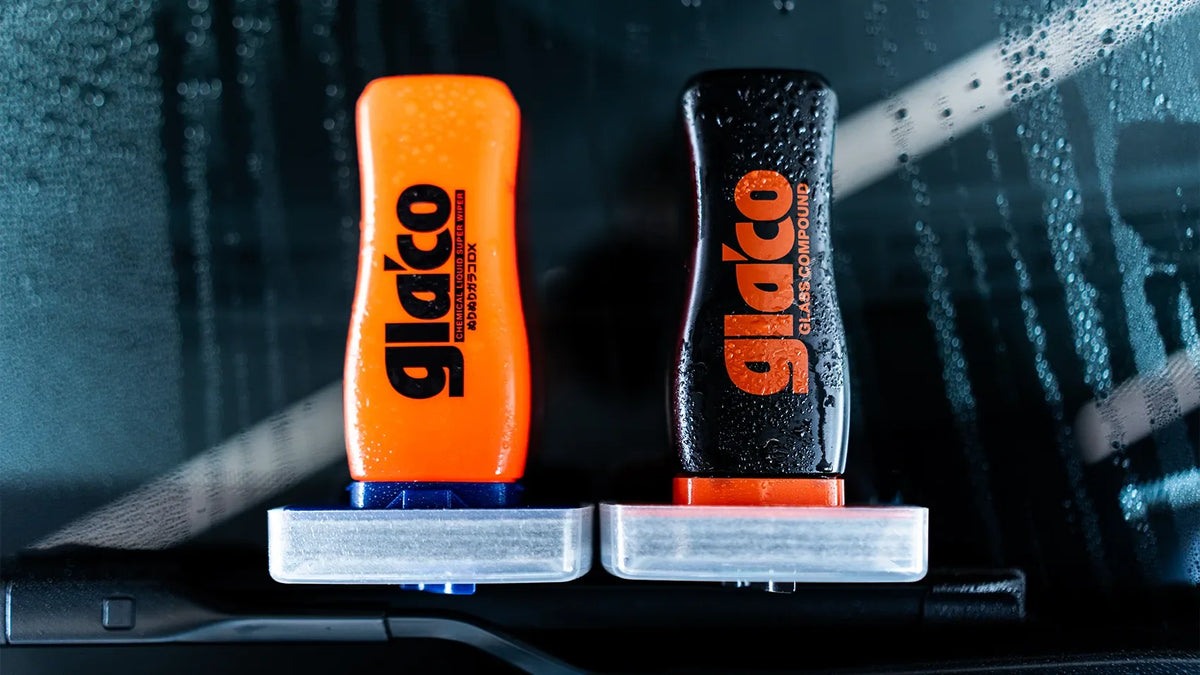
Water runs off, flees, gets repelled, or is shed – the hydrophobic effect goes by many names. But do you know how it actually works? Or perhaps you've already applied Glaco but are struggling with chattering wipers? We're here to help and explain!
Today we're taking you into the world of Glaco, where we'll do our best to demystify the magic behind Japan's iconic orange glass coatings. We'll also share a few tips for those who want to get even more out of their Glaco.
The story of the orange coatings began quite differently from what you might expect – because Glaco wasn't developed for cars, but for... aircraft! Pilots needed better visibility in challenging conditions, and so in 1990, Soft99 brought the first hydrophobic glass solution to market.

It didn't take long for the technology to reach everyday drivers. By 1991, the first of them were holding a Glaco product in their hands, ready to apply it to their own windscreens, and the magical effect became widely accessible. But how does it actually work?
It's not magic – it's chemical perfection
Is glass smooth? It may seem so, but in reality it's a porous material. Under magnification, its surface reveals hundreds of thousands of microscopic indentations. This means that unprotected glass effectively traps water that settles on it, and over time those pores also fill with deposits, dirt and an oily road film. The secret of Glaco lies in effectively filling those pores and perfectly smoothing the surface.
Once the glass is protected this way, water runs off freely under gravity, and while driving, droplets are literally blown away by the flow of air. Glaco also reduces the contact area between the droplet and the glass, which further aids the whole process. Want to see it in action? Take a look at how perfectly round the beads are after applying Glaco! We mentioned dirt earlier – and that's just as important a point as the protection itself...
Preparation is everything
Would waxing dirty paintwork make it gleam? Absolutely not – and exactly the same applies to Glaco applied to an unprepared windscreen. Even the finest coating won't do its job on dirty, greasy glass full of stubborn deposits. Its performance will be weak or barely noticeable, and its durability significantly reduced.

The foundation, then, is proper and thorough glass cleaning. Forget about degreasing with alcohol, polishing compounds, glass pastes or other DIY methods – these simply aren't enough, or require professional experience to use correctly. For this task, it's worth choosing something far simpler and more effective. What's that? Glaco Compound Roll On or Compound Z! A specially formulated blend of chemical and abrasive agents based on cerium oxide will remove everything unwanted from the glass surface in a single step – including years of limescale and mineral deposits. Everything you need to get started comes included.
Cutting corners isn't worth it: chattering wipers and other problems
If you skip the preparation stage, there's a fairly good chance that Glaco won't meet your expectations. No effect at low speeds? Protection that disappears after a couple of weeks? Or perhaps the frustrating problem of chattering wipers while driving?
The latter is most commonly caused by inadequate glass preparation. Glaco applied to such a surface covers it unevenly and alters its properties in unpredictable ways. A wiper blade operating in these conditions encounters varying resistance, and each such moment causes it to judder. Add in worn wiper blades and the problem becomes almost inevitable. So what can you do about it?
- Preparation: thoroughly prepare the glass using Glaco Compound Roll On or Compound Z. For extra certainty, you can repeat the process twice.
- Correct technique: reapply Glaco carefully, making sure to cover every part of the glass. A cross-pattern application method gives greater confidence here. Watch our "How to Apply" guides if you need help.
- Good, fresh wiper blades: replace your wipers with new ones. Bear in mind that specialists and manufacturers recommend replacing them every six months, ideally at the change of seasons between winter and summer. If you cover a high mileage, you may need to replace them more often.
- Glaco on the wiper blade: some cases also require treating the wiper blades themselves with Glaco – simply touch the applicator to the rubber part of the blade and draw it along the surface. Alternatively, apply Glaco to a clean microfibre cloth by gently squeezing the bottle, then wipe the cloth along the blade.
- Wiper mechanics: finally, check that the metal wiper arms aren't bent or misaligned, and that the wiper mechanism itself has no play in it.
Glaco can do much more!
Hydrophobic performance isn't the only power Glaco has to offer – and its many benefits can be enjoyed all year round, even through dry, hot summers. How? The coating acts like a shield for your glass. In the rain it repels water, in winter it reduces frost and ice adhesion, and in summer it makes it easier to remove insect residue, bird droppings and tree sap. As a result, you'll be reaching for certain items far less often – in the rain your wipers will have far less work to do, in winter you won't always need your ice scraper, and in summer a blast of pressurised water is often all it takes to restore clarity and cleanliness to your glass.
Let's not forget the invaluable contribution that clean, water and dirt-repelling glass makes to driving safety and comfort. A regularly cleaned windscreen stays clear in all conditions – something you'll particularly appreciate after dark, when oncoming headlights no longer illuminate deeply embedded grime. It's for good reason that we began talking about Glaco in terms of road safety in our Drive Safe campaign.
Summary
You'll appreciate Glaco whether you're a fan of immaculate cars or simply value comfort and visibility while driving. These Japanese glass coatings were created to make life easier for drivers and motorcyclists around the world. It's no wonder that millions of drivers have put their trust in Glaco and Soft99.