
 Europe | €
 Deutschland | €
 Italy | €
 Polska | zł
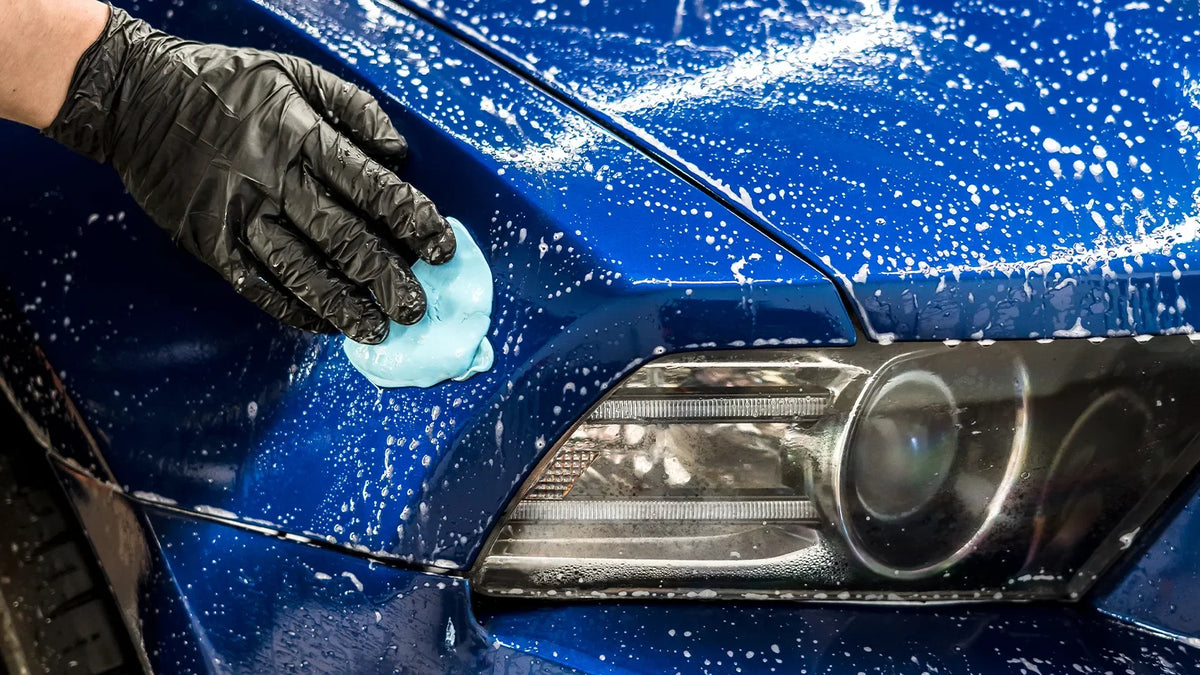
Clay bars are among the most useful detailing products in the decontamination process. They're essential for anyone who wants to thoroughly prepare their vehicle before applying a coating or wax – and they also do an excellent job on neglected paintwork. Here's what you should know about them.
Detailing clay bars can be compared to a kind of dirt magnet. With tremendous force – while remaining completely safe for the paintwork – they "lift" all manner of deeply embedded metallic, bituminous and organic contaminants from the surface.
See how many of the tips below you already know about working with clay bar without causing harm to the paint!
Warm the clay bar before use
The principle is simple – clay bar needs warmth to stay pliable, soft and gentle on the paintwork. Before starting, it's worth placing the clay bar in a bowl of warm (but not hot!) water for a moment. Our tip? Divide the clay bar into 2 pieces and work with them alternately – one in the warm water, one in action.
Lubrication
Clay bar needs good lubrication to glide across the surface without resistance. Products that provide lubrication for clay bar work is a topic that could fill a book, and every detailer will have their own favourite solution in this category.

Our advice? Save your money. You don't need any additional product here. Mix water with a small amount of neutral pH car shampoo (QJUTSU Creamy Shampoo is ideal for this) and pour it into a spray bottle. We suggest a ratio of 50 ml of shampoo to 1 litre of water.
Long, straight strokes
A clay bar is not a scrubbing brush. Don't press it hard into the paintwork or work intensively in one spot. Give it a suitably long stroke and work horizontally. Even if you do pick up a stray grain of sand and leave the odd scratch, it won't refract light in such a visible way and will be easier to remove afterwards.
Never work with a dirty clay bar
If you drop your clay bar, even if it's a piece fresh out of the packaging, it belongs in the bin. The moment it hits the floor, particles of sand and dirt will stick to it instantly. That's terrible news for your car's paintwork, so don't hesitate to reach for a fresh piece.
Not just paintwork!
Did you know you can clay bar other smooth surfaces too? This includes glass, chrome, transparent plastics and alloy wheels. Do avoid unpainted plastics with a visible texture, however.
Which detailing clay bars do we recommend?
Soft99 is a Japanese company – something we say with great pride – and the concept of the car care clay bar originates from Japan. There's nowhere better to source one from, don't you think?
The most popular option is the QJUTSU Clay Bar – super-soft and super-gentle, as befits all products from the QJUTSU range, which are designed to protect paintwork to the greatest possible degree. The clay bar is so gentle that you can use it to spot-clean paintwork already protected with wax or a coating, without any concern. Extremely easy and user-friendly, it's the ideal first clay bar for any paintwork.

The second option is the Surface Smoother clay bar – equally soft, but more "aggressive", designed for truly neglected paintwork. This is a clay bar aimed at more experienced users. Professional detailers who know they'll be carrying out a paint correction after the clay bar treatment will particularly appreciate what it can do.
Summary
Bear in mind that in some situations, paint correction after clay bar work may be necessary – so our final tip: clay bar as part of a complete decontamination process, not as a standalone step.
And lastly: don't be afraid to clay bar! These little wonders cost very little, yet they can achieve a great deal – particularly on neglected paintwork.